
Segment-Level GEO: Mapping LLM Visibility by Buyer Group
By Velocity AI · September 21, 2026 · 8 min read
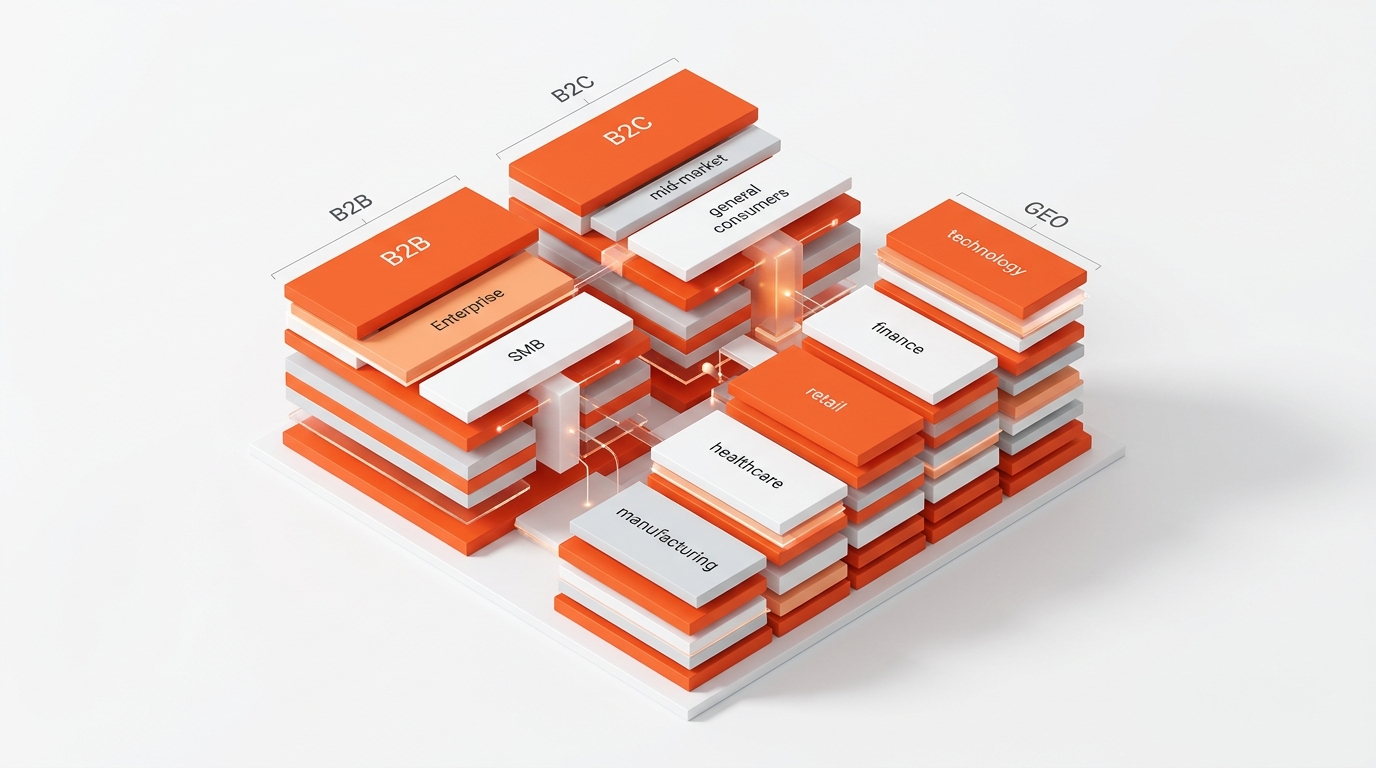
Breaking GEO visibility down by customer segment — B2B vs. B2C, SMB vs. enterprise, by vertical — reveals which buyer groups have the biggest visibility gaps and the highest upside for targeted content.
Why Aggregate GEO Scores Leave Enterprise Brands Flying Blind
Segment-level GEO buyer visibility across enterprise, SMB, and vertical buyer groups is the measurement discipline most large brands have not yet operationalized, and it is costing them real pipeline. Fewer than 20 percent of enterprise brands currently measure LLM citation share at the buyer-segment level, which means the other 80 percent are optimizing content against an audience they cannot actually see.
A single GEO score tells you how often your brand appears in LLM responses. It does not tell you whether those appearances happen when a VP of Procurement at a health system is asking about vendor compliance, or when a consumer is asking which product to buy for personal use. Those are fundamentally different queries, different citation ecosystems, and different content requirements. Treating them as one measurement problem produces content strategy that serves no segment particularly well.
This post introduces the Segment Citation Mapping framework: a structured methodology for breaking GEO visibility down by buyer group, identifying which segments are underserved by current content, and translating that analysis directly into content brief scopes that drive measurable LLM citation share.
Fewer than one in five enterprise brands currently measure LLM citation share at the buyer-segment level, leaving the majority optimizing content against an undifferentiated audience.
Source: Velocity AI client benchmarking, 2025
The Segment Citation Mapping Framework
Segment Citation Mapping is a four-phase process that moves from buyer group definition through query architecture, citation measurement, and content brief production. Each phase builds on the prior one, and the output of the full cycle is a prioritized content roadmap tied to specific buyer segments and measurable citation gaps.
Phase 1: Define Your Buyer Segment Taxonomy
Before any query is run or any citation measured, you need a precise definition of the buyer groups that matter commercially. This sounds obvious, but most brands conflate segments they should be separating.
Start with three axes:
- Business model: B2B versus B2C, and within B2B, whether the buyer is a direct purchaser or an influencer in a committee
- Organizational scale: Enterprise (typically 1,000-plus employees, complex procurement), mid-market, and SMB, each of which asks LLMs fundamentally different questions about the same product category
- Vertical or industry: A healthcare IT buyer has compliance constraints that a retail buyer does not. A financial services procurement team has risk framing that a manufacturing buyer does not share
The output of Phase 1 is a segment taxonomy: a defined list of buyer groups, typically four to eight for a complex enterprise brand, each with a short profile describing their primary purchase concern, their organizational context, and the lens through which they evaluate vendors.
This taxonomy becomes the skeleton of everything that follows. If it is imprecise, every downstream measurement will be noisy.
Phase 2: Build Segment-Specific Query Sets
LLM queries from a healthcare buyer differ structurally from a consumer query. A health system evaluating a technology vendor will ask questions about HIPAA compliance pathways, integration with existing EHR infrastructure, audit trail capabilities, and vendor liability. A consumer asking about a similar product category will ask about price, ease of use, and what others recommend.
For each segment defined in Phase 1, build a query set that reflects how that buyer actually uses an LLM in their purchase process. This requires primary research: interviews with sales and customer success teams, analysis of sales call transcripts, and review of the questions that appear in RFPs and vendor evaluation processes.
A well-constructed segment query set includes:
- Awareness-stage queries: How does this buyer first frame the problem the product solves?
- Evaluation-stage queries: What criteria does this buyer use when comparing vendors?
- Decision-stage queries: What risk or compliance questions does this buyer ask before committing?
For a hardware brand serving enterprise IT, SMB owners, and consumer electronics buyers, those three query types will look completely different across segments. The enterprise IT buyer asks about endpoint management integration. The SMB owner asks about setup time and support. The consumer asks about compatibility with existing devices.
This is where running a niche-level GEO audit by category and segment intersects directly with buyer research. The query sets you build in Phase 2 are the measurement instrument for everything that follows.
Phase 3: Measure Citation Share by Segment
With query sets in hand, run each set across the primary LLM platforms relevant to your buyer segments. Enterprise buyers tend to use ChatGPT and Microsoft Copilot. Consumer buyers skew toward ChatGPT and Google's AI Overview. Segment your measurement accordingly.
For each query, record:
- Whether your brand is cited
- Where in the response the citation appears (primary recommendation, secondary mention, or comparative context)
- Which competitors are cited instead when your brand is absent
- The framing around any citation (positive, neutral, conditional, or risk-flagged)
The output is a segment citation matrix: a structured view of citation share for each brand, across each query type, for each buyer segment. This is the diagnostic instrument that makes segment-level GEO analysis actionable rather than descriptive.
Enterprise buyer query sets generate citation results that differ by a factor of three or more from consumer query sets for the same brand, based on Velocity AI segment audits for hardware clients spanning enterprise, SMB, and consumer segments.
Source: Velocity AI client data, 2024–2025
Velocity AI by CourtAvenue maps citation share by segment for hardware clients spanning enterprise, SMB, and consumer buyers. The pattern is consistent: brands with strong consumer-facing content perform well on consumer queries and poorly on enterprise procurement queries. Brands that have invested in technical documentation and compliance content show the inverse. Almost no brand enters this analysis performing well across all segments, which is precisely why the matrix is useful.
It is also worth noting that citation behavior varies by model. Understanding how different LLMs weight sources for different query types is a prerequisite for interpreting segment citation data accurately.
Phase 4: Translate Gaps into Content Brief Scope
Segment analysis directly informs content brief scope: who the piece is for, what problem it solves, and what citation gap it is designed to close.
A content brief produced from Phase 3 data includes:
- Target segment: The specific buyer group this content is designed to serve, including organizational scale and vertical context
- Query cluster: The three to five queries this content is designed to appear in response to
- Citation gap: The current citation share for this segment and the competitive brands currently filling the gap
- Content angle: The specific framing, depth level, and evidence type that serves this buyer's evaluation criteria
- Success metric: The citation share target for this content across the query cluster, measured at the next audit cycle
This is a fundamentally different brief structure than what most content teams use. It is audience-specific, gap-driven, and tied to a measurable outcome. It is also the structure that prevents content investment from being spread evenly across segments regardless of where the upside actually sits.
For enterprise brands managing content at scale, this brief structure integrates directly with the GEO scorecard methodology for tracking progress across segments over time.
Common Failure Modes
Defining segments by internal org chart rather than buyer behavior. A segment taxonomy built around how your sales team is organized does not reflect how buyers actually ask LLMs questions. Segments must be defined by query behavior, not internal convenience.
Running the same query set across all segments. This is the most common error. Generic queries produce aggregate results that mask segment-level gaps. If your query set does not include compliance and integration questions for enterprise buyers, you will not detect the citation gaps that matter most to your largest accounts.
Measuring once and treating it as permanent. LLM citation patterns shift as models are updated, as competitors publish new content, and as buyer query behavior evolves. Segment citation matrices need to be refreshed on a quarterly cycle to remain actionable. A one-time audit is a diagnostic, not a strategy.
Producing content without segment scope. The most expensive failure mode is completing a rigorous segment analysis and then handing the findings to a content team that writes general-purpose pieces. The brief must carry the segment context through to production, or the analysis does not convert into citation share.
If your current GEO measurement infrastructure is built on off-the-shelf trackers, it is worth reviewing why commercial GEO trackers fall short for enterprise brands before investing in segment-level measurement at scale.
Key Takeaways
- Aggregate GEO scores hide segment gaps. A single citation share number cannot tell you whether your brand is visible to enterprise procurement buyers versus consumer buyers. Those gaps require separate measurement.
- Query structure is segment-specific. Enterprise buyers ask LLMs about compliance, integration, and risk. Consumer buyers ask about features and price. The same content cannot serve both query types effectively.
- The segment citation matrix is the core diagnostic. Mapping citation share by buyer group, query type, and competitive position reveals which segments represent the highest upside for targeted content investment.
- Content briefs must carry segment scope. Analysis that does not translate into segment-specific brief parameters will not produce content that closes citation gaps. The brief structure is where GEO strategy becomes content execution.
- Measurement cadence matters. Segment citation data has a shelf life. Quarterly refresh cycles are the minimum standard for brands competing in categories where LLM citation patterns are actively shifting.
Get the weekly AI brief for enterprise leaders
Strategy, deployment patterns, and what's actually working in enterprise AI — no fluff.
Frequently Asked Questions
What is segment-level GEO and how does it differ from standard GEO analysis?
How do LLM queries differ between enterprise buyers and SMB or consumer buyers?
How long does a segment-level GEO audit take for an enterprise brand?
What outputs should a segment-level GEO analysis produce?
Related Insights

Finding the White Space: How to Identify LLM Citation Gaps Before Competitors Do
8 min read · Sep 14, 2026
Read more
From Generic Queries to Product Categories: How to Run a Niche-Level GEO Audit
8 min read · Aug 31, 2026
Read more
Building a GEO Scorecard: How to Measure LLM Visibility for Enterprise Brands
8 min read · Jul 20, 2026
Read more