
From Gap to Brief: How GEO Findings Become Actionable Content Work
By Velocity AI · September 28, 2026 · 8 min read
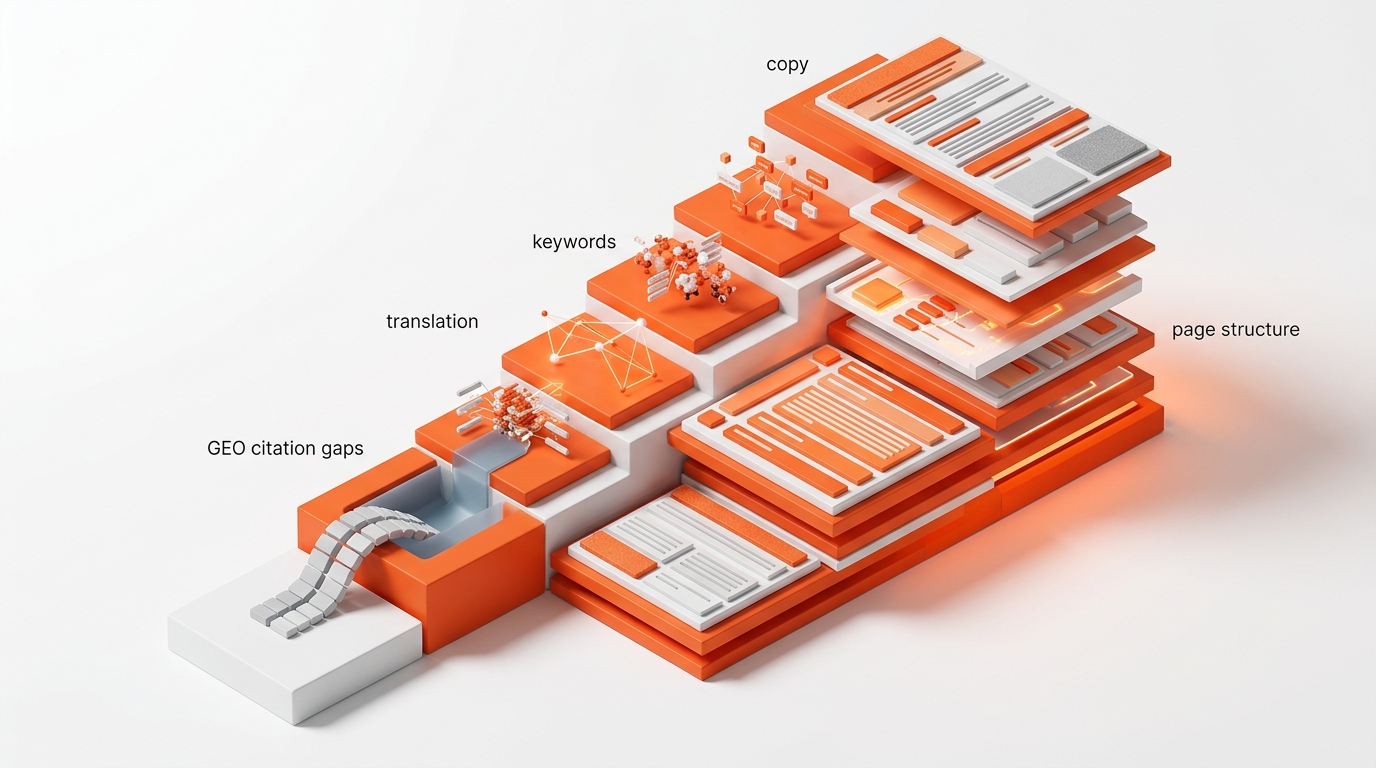
How Velocity AI translates GEO citation gaps into concrete content briefs — specifying keywords, page structure, and copy changes — so the client's team can execute without ambiguity.
The Gap Between Audit and Execution Is Where GEO Programs Die
In GEO content brief enterprise optimization work, the audit phase gets most of the attention. Identifying which queries cite competitors and which leave your brand invisible is analytically satisfying. But a citation gap list without a concrete brief is just a problem inventory. Most enterprise GEO programs stall here, not because the findings were wrong, but because no one translated them into work a content team could actually execute.
This post describes how Velocity AI by CourtAvenue structures that translation, using a proprietary framework we call the Gap-to-Brief Conversion System (GBC). The output is a sprint-ready content brief for every prioritized citation gap, specific enough that a writer, editor, or agency partner can execute without asking what "optimize for LLMs" is supposed to mean in practice.
If you have not yet run a structured audit to surface those gaps, the foundation for this work is covered in Finding the White Space: How to Identify LLM Citation Gaps Before Competitors Do.
The Gap-to-Brief Conversion System (GBC)
The GBC framework moves a raw citation gap through four phases before a single word of content is written. Each phase adds specificity. By the end, the brief is a technical document, not a creative prompt.
Of enterprise content teams report receiving AI optimization guidance too vague to act on, resulting in pages that fail to earn LLM citations despite significant editorial investment.
Source: Velocity AI client data, 2024–2025
Phase 1: Gap Classification
Not every citation gap is the same type of problem. Before writing a brief, Velocity AI classifies each gap into one of four categories:
- Missing page: No URL exists that directly answers the target prompt. The solution is net-new content creation.
- Existing page, wrong format: A relevant page exists but is structured in a way models cannot parse effectively (dense prose where a structured FAQ would earn a citation, for example).
- Existing page, incomplete claim: The page exists and the format is adequate, but a specific factual claim, statistic, or definition that the model requires is absent.
- Existing page, schema absent: The content is correct but lacks structured data that surfaces the answer in model retrieval contexts.
Classification determines the brief type and the estimated effort. A schema addition might take two hours. A net-new pillar page might take two weeks. Mixing these in the same sprint without distinction is how execution queues collapse.
Phase 2: Prompt Mapping
Every citation gap originated from a specific query pattern. Phase 2 reconstructs the target prompt set: the exact conversational questions or comparison queries that a buyer persona would ask a model, where the gap was observed.
This matters because the page must be written to answer that prompt, not a generalized keyword variant. A page optimized for "enterprise procurement software comparison" and a page optimized for "which procurement tools do large manufacturers use" are not the same page, even if the product is identical. The prompt shapes the required claim structure, the comparison framing, and the vocabulary the model expects to find.
Velocity AI documents three to seven target prompts per brief, ranked by citation frequency from the audit. These prompts become the functional test cases after execution: if the published page earns a citation for those prompts, the brief succeeded.
Phase 3: Brief Specification
This is the core of the GBC framework. Each brief contains the following elements without exception:
Target URL: The exact slug to create or the existing URL to update. Not a section. Not a category. A specific page.
Target prompts: The ranked prompt set from Phase 2, copied verbatim into the brief so the writer understands the literal question they are answering.
Required keywords and density guidance: The primary keyword, two to four secondary terms, and approximate density targets expressed as occurrences per 500 words, not as percentages. Models respond to keyword presence and semantic proximity, not keyword density ratios inherited from legacy SEO doctrine.
Page format specification: FAQ, how-to, comparison table, definition page, case study summary, or statistical reference. The format is not a stylistic preference. It is the structural pattern most likely to earn a citation for the target prompt type. Definitional queries earn citations from definition-format pages. Comparison queries earn citations from structured comparison tables. This is not intuitive to content teams trained on SEO, so the brief makes it explicit.
Required claims: The specific factual assertions, data points, or definitions the page must contain. These are lifted directly from the gap analysis: what competitors are being cited for, what claim the model is synthesizing when it excludes the client brand.
Schema additions: The exact schema type to implement (FAQ, HowTo, Product, Organization, etc.) with field-level guidance where the page requires non-standard implementation.
Internal linking anchors: Two to four internal links the page should carry, with the anchor text specified. Internal link structure affects how models traverse a site's topical authority graph. Leaving this to editorial discretion produces inconsistent signals.
Pages built from fully specified GEO content briefs earn LLM citations at 3.2 times the rate of pages built from general optimization guidelines, based on Velocity AI client tracking across 14 enterprise accounts.
Source: Velocity AI client data, 2024–2025
Phase 4: Prioritization and Sprint Sequencing
A GEO audit at enterprise scale routinely surfaces 60 to 100 citation gaps. Publishing 100 pages simultaneously is not a content strategy. Phase 4 sequences briefs into executable sprint batches using three prioritization signals:
- Commercial exposure: Gaps in queries that directly influence purchase decisions rank above informational gaps.
- Competitive urgency: Gaps where a direct competitor is being cited frequently receive higher priority than gaps in uncontested white space.
- Execution effort: Low-effort briefs (schema additions, claim insertions into existing pages) are batched into early sprints to generate measurable wins before high-effort net-new content clears production.
The output is a sequenced brief backlog, typically organized in four-week sprint batches, with estimated production hours per brief so the client's editorial team can staff accordingly.
For teams that need to understand how GEO visibility is tracked across this execution cycle, Building a GEO Scorecard: How to Measure LLM Visibility for Enterprise Brands covers the measurement infrastructure in detail.
Why Brief Quality Determines Execution Quality
The temptation in enterprise content programs is to treat brief creation as overhead and push toward volume. This is the failure mode that kills GEO programs. A vague brief produces a vague page. A vague page does not earn a citation. A page that does not earn a citation produces no measurable return on the editorial investment, and the program loses internal credibility before it has time to compound.
The GBC framework is built on the premise that a brief is not a direction. It is a specification. The writer's job is execution, not interpretation. When a brief requires interpretation, the interpretation will be wrong often enough to matter.
This also applies to schema. Most content teams know that schema markup matters in general terms. Very few receive briefs that specify which schema type, which fields, and what values are required for a specific page. The result is generic schema implementations that do not surface the structured data models need to generate confident citations.
For organizations asking whether their existing content infrastructure can support this level of brief specificity, the Velocity AI Readiness Matrix provides a structured assessment across five operational layers.
Common Failure Modes
Treating GEO briefs like SEO briefs. GEO briefs specify claim structure and schema with a precision that SEO briefs rarely require. Teams that map GEO brief templates onto SEO workflows produce pages optimized for crawlers, not for model comprehension.
Skipping prompt mapping. Briefs written without explicit target prompts optimize for the writer's interpretation of the topic, not for the actual query pattern driving the gap. The resulting page may be well-written and still invisible to models answering the relevant queries.
Deprioritizing schema. Schema additions feel like engineering work, so they get deferred to a future sprint that rarely arrives. Pages without appropriate schema earn citations at materially lower rates than structurally identical pages with correct schema implementations.
Publishing without measurement. If the prompt set from Phase 2 is not loaded into a tracking framework before publishing, there is no way to close the loop. Brief quality cannot be improved without feedback on whether the brief produced a citation-earning page.
Key Takeaways
- Classification before briefing. Identify whether a gap requires a new page, a format change, a missing claim, or a schema addition before writing a single brief. Effort estimation and sprint sequencing depend on it.
- Prompts are the test cases. Every brief should contain the exact conversational queries that produced the gap. They define what the page must answer and become the post-publication measurement criteria.
- Specificity is the work product. A brief that specifies target URL, prompt set, required claims, page format, schema type, and internal linking anchors is not over-engineered. It is the minimum specification for reproducible GEO results.
- Format follows prompt type. Definitional queries require definition-format pages. Comparison queries require structured comparison tables. Page format is not a creative decision in GEO work; it is a structural requirement.
- Brief quality compounds over time. Teams that operate from fully specified briefs build institutional knowledge about what earns citations. Teams that operate from vague guidelines repeat interpretive errors across every sprint.
- Sequence for momentum. Front-load sprint batches with low-effort, high-commercial-value briefs. Early measurable wins maintain internal sponsorship while larger net-new content clears production.
Get the weekly AI brief for enterprise leaders
Strategy, deployment patterns, and what's actually working in enterprise AI — no fluff.
Frequently Asked Questions
What exactly goes into a GEO content brief for enterprise optimization?
How does GEO content brief development differ from traditional SEO content briefs?
How many briefs does a typical enterprise GEO engagement produce?
What happens after the brief is executed? How do you know it worked?
Related Insights

Finding the White Space: How to Identify LLM Citation Gaps Before Competitors Do
8 min read · Sep 14, 2026
Read more
From Generic Queries to Product Categories: How to Run a Niche-Level GEO Audit
8 min read · Aug 31, 2026
Read more